Informational guide
Can You Deduct Health Insurance Premiums as a Self-Employed Worker?
This guide consolidates the essentials freelancers and 1099 earners need to know about the self-employed health insurance deduction. If you’re paying for health coverage on your own, you may be able to reduce your AGI by the cost of the premiums. In the first quarter, searches surge as tax season approaches—understanding the rules can unlock meaningful savings.
- Self-employed health insurance deduction can lower your adjusted gross income (AGI) by premiums you paid for yourself, your spouse, and your dependents.
- For many freelancers, the deduction is effectively 100% of the premiums, subject to eligibility criteria.
- Keywords to explore: self employed health insurance deduction, freelancer health insurance tax deduction, 1099 health insurance deduction.

Eligibility & Requirements
If you’re self-employed and paying for health insurance, you may qualify for the self-employed health insurance deduction. The deduction is an above-the-line deduction, meaning it reduces adjusted gross income rather than being claimed as an itemized deduction.
- You are self-employed, a sole proprietor, or file as an independent contractor (including 1099-MISC/1099-NEC).
- You paid health insurance premiums for yourself, your spouse, and dependents during the year.
- The premiums are for health and qualified long-term care coverage, not limited-scope coverage beyond health plans.
- You reported self-employment income on Schedule C or similar forms and file Form 1040 with the proper deduction on Schedule 1.
What counts as a deduction?
Premiums you paid for health insurance for yourself, your spouse, and dependents may be deductible. The deduction reduces your gross income, not your self-employment tax. It generally applies to medical insurance premiums paid during the year for qualified plans.
- Medical, dental, and qualified long-term care insurance premiums
- Premiums paid for coverage through a marketplace plan if you’re self-employed
- Premiums paid for your spouse if they do not have access to employer coverage
How the Self-Employed Health Insurance Deduction Works
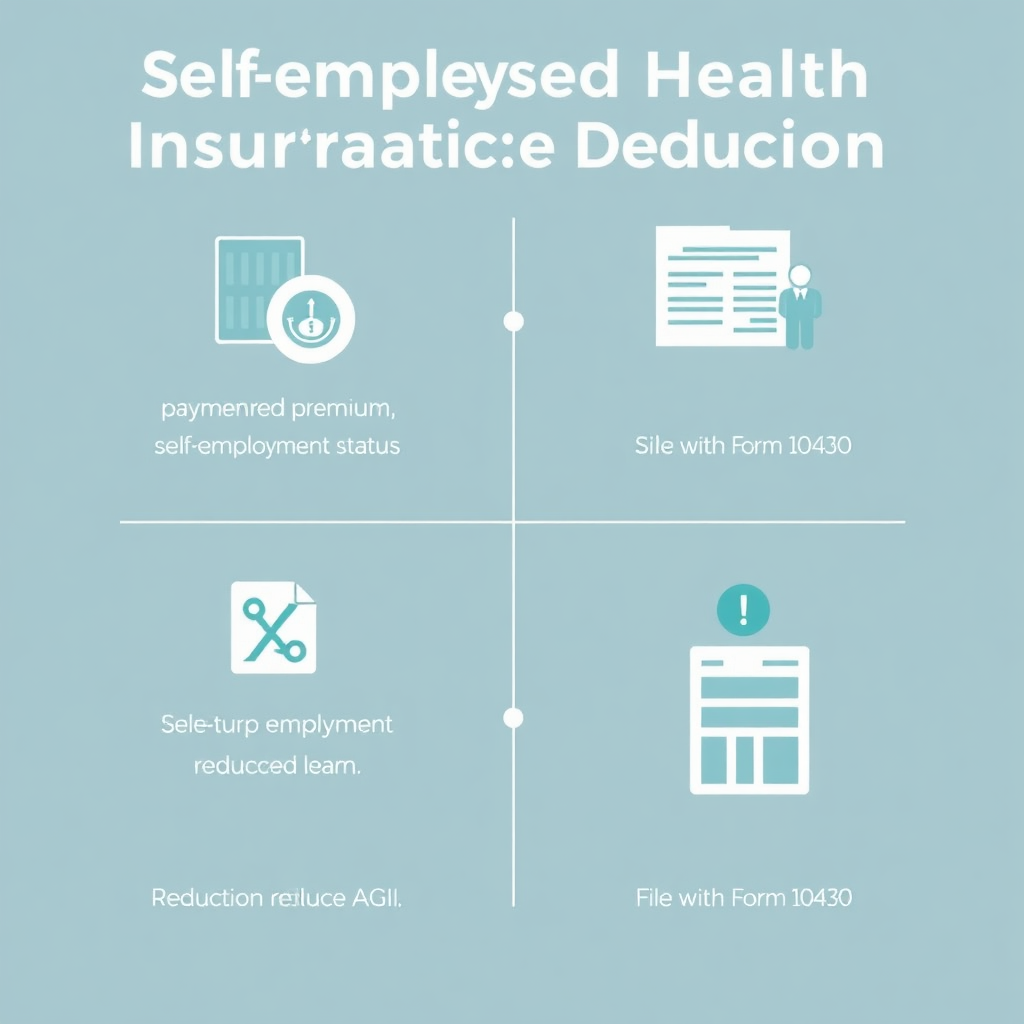
The deduction is designed to lower your AGI by premiums paid for qualified health insurance. It applies to you, your spouse, and dependents, and it’s available regardless of whether you itemize deductions. The steps below summarize the typical flow for freelancers.
- Step 1: You pay health insurance premiums during the year for yourself and eligible family members.
- Step 2: You determine eligibility based on your self-employment status and coverage type.
- Step 3: You calculate the deduction amount, which reduces your AGI on the front end of your tax return.
- Step 4: You report the deduction on Form 1040, typically on Schedule 1 as an above-the-line deduction.
Illustrative diagram
Calculation & Examples
For many self-employed individuals, health insurance premiums are deductible as an above-the-line deduction. That means you can reduce your gross income by the amount you paid in premiums, potentially lowering your marginal tax rate. The exact impact depends on your income, family size, and coverage.
Below are two illustrative scenarios to demystify the effect. These examples are for educational purposes and are not tax advice. Always consult a tax professional for your personal situation.
Individual Plan
Scenario APrem Premiums paid: $4,200/year
Family Plan
Scenario BPrem Premiums paid: $10,200/year
Interactive Quick Calculator
Enter your annual premiums to see the potential deduction. This is a simplified illustration.
Documentation & Filing
Gather the documents you’ll need to support the deduction. While the self-employed health insurance deduction is an above-the-line deduction, you’ll still want to retain records in case of an IRS inquiry. Below is a practical checklist and suggested workflow.
- Proof of health insurance premiums paid for the year (receipts, insurer statements)
- Evidence of self-employment income (Schedule C, Schedule SE, or other forms you file)
- Proof that coverage extends to you, your spouse, and dependents as applicable
- IRS guidance references: official pages describing the self-employed health insurance deduction
Step-by-step Filing Tips
- Track premiums as you pay them during the year; keep receipts and statements organized.
- When filing, enter the deduction amount as an above-the-line deduction on Schedule 1 (Form 1040).
- Double-check the deduction eligibility, especially if your household coverage includes non-dependent persons.
- Consult a tax professional if your situation includes special circumstances (e.g., multi-state coverage, changes in self-employment status).